

Comprehensive Accounting Study Guide
Grade 12 Senior Certificate Preparation
This study guide is designed to help Grade 12 Accounting students prepare effectively for their Senior Certificate Examinations. It consolidates key concepts, examination guidance, and practical tips for both Paper 1 (Financial Reporting and Evaluation) and Paper 2 (Managerial Accounting and Internal Controls).
1. Introduction
This guide aims to bridge content gaps and strengthen your mastery of core Accounting concepts. It provides a structured approach to understanding financial information analysis and interpretation, crucial skills for both papers.
2. General Study and Examination Tips
- Understand Paper Structure:
- Paper 1: Financial Reporting and Evaluation (150 marks, 2 hours)
- Paper 2: Managerial Accounting and Internal Controls (150 marks, 2 hours)
- Examination Guidelines: Familiarize yourself with official guidelines and exemplar papers.
- Study Timetable: Create a focused timetable by topic.
- Time Management: Practice timed questions and shortcut techniques.
- Language: Focus on key vocabulary and action verbs.
- Show Workings: Always show calculations for part-marks.
- Question Layout: Understand "Appetizer, Required, Information" format.
- Answer Book: Use it effectively to save time.
- Reading Time: Use the first 10 minutes to plan your approach.
- Answer Order: Start with easier sub-questions.
- Legibility: Write clearly and neatly.
- Concise Comments: Keep comments short and mark-guided.
- Stationery: Bring all essentials, including a non-programmable calculator.
- Knowledge vs. Rote Learning: Focus on understanding, not memorizing.
- Positive Comments: Use constructive language when commenting.
- Work Backwards: Be able to deduce missing information.
3. Understanding the Year-End Cycle
Financial statements are the culmination of a year-end cycle:
- Pre-adjustment Trial Balance: Initial balances.
- Adjustments: Accruals, prepayments, depreciation, etc.
- Post-adjustment Trial Balance: Updated balances.
- Closing Transfers: Transfer nominal accounts.
- Financial Statements:
- Statement of Comprehensive Income (Income Statement)
- Statement of Financial Position (Balance Sheet)
- Notes to the Financial Statements
- Cash Flow Statement
- Analysis and Interpretation: Decision-making based on financials.
4. Analysis and Interpretation of Financial/Non-Financial Information
This process extracts relevant information from financial statements to meet specific needs for decision-making.
Key Concepts and Explanations
- Analysis and Interpretation: Extract and interpret financial data for decision-making.
- Users and Reasons:
- Shareholders: Assess profitability.
- Financial Institutions (short-term): Evaluate short-term debt capacity.
- Financial Institutions (long-term): Assess long-term loan repayment ability.
- SARS: Ensure correct tax payment.
- Management: Measure performance.
- Customers: Gauge business longevity.
- Auditors: Verify fair presentation.
- Employees/Unions: Assess growth and employment prospects.
- Comparison Benchmarks:
- Previous years (most meaningful)
- Competitors
- Industry averages
Areas of Analysis
| Area of Analysis | Description |
|---|---|
| Profitability | Measures ability to generate profit from operations and assets. Includes mark-up, margins, ROI. |
| Liquidity | Assesses ability to meet short-term obligations. Focus on current assets vs. liabilities. |
| Solvency | Evaluates long-term financial stability and ability to meet obligations. |
| Return | Measures management effectiveness in generating shareholder and lender returns. |
| Risk & Gearing | Examines reliance on debt vs. equity. High gearing = higher risk and potential return. |
| Share Price | Reflects market perception of value and future prospects. |
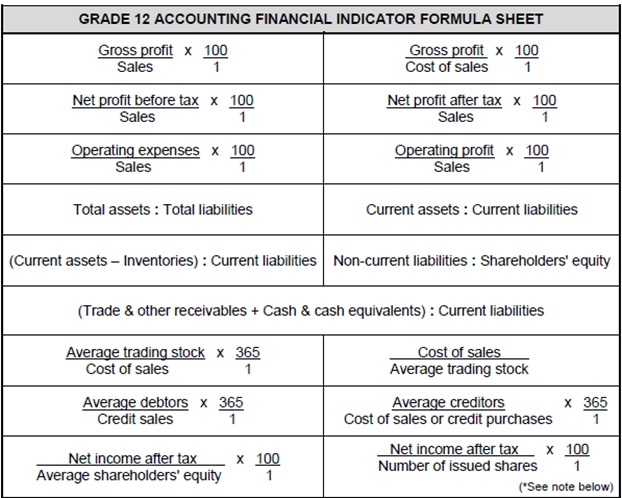
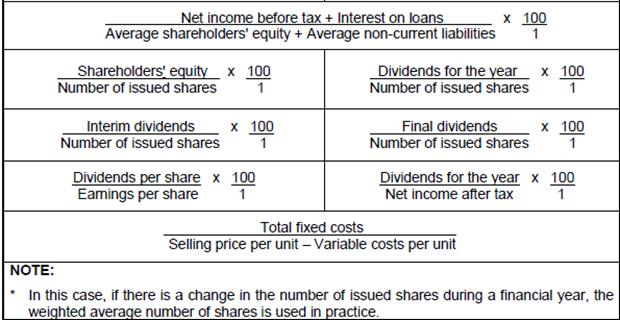
Financial Indicators and Formulae
Note: A comprehensive formula sheet is typically provided in the exam. Focus on understanding common indicators and their application.
5. Paper 1: Financial Reporting and Evaluation
Question 1: Company Financial Statements (55–60 Marks; 45 Minutes)
Synopsis: Tests your ability to prepare financial statements after adjustments.
- Tasks:
- Prepare Statement of Comprehensive Income
- Prepare sections of Statement of Financial Position
- Calculate adjustments: depreciation, asset disposal, inventory valuation, provision for bad debts, accruals, prepayments, directors' fees, loan interest, income tax
- Information Provided:
- Pre-adjustment Trial Balance
- Adjustment notes and additional info
- Key Calculations:
- Depreciation & Asset Disposal: method, timing, carrying value, profit/loss
- Stock Valuation: FIFO or Weighted-Average
- Adjusting Entries: accurate income/expense and asset/liability balances
- Income Tax: final expense and SARS balance
- Tips:
- Complete adjustments first
- Cross-reference impacts
- Show all workings
- Understand account types
Question 2: Cash Flow Statement and Financial Indicators (35–40 Marks; 25–30 Minutes)
Synopsis: Focuses on cash movement and financial ratios.
- Tasks:
- Prepare Retained Income Note
- Calculate CFS figures: Cash Generated from Operations, Operating/Investing/Financing Activities
- Calculate indicators: Current Ratio, NAV per share, ROTCE
- Information Provided:
- Income Statement and comparative Balance Sheet extracts
- Notes on share capital, dividends, loans, fixed assets
- Key Calculations:
- Retained Income Note
- Cash Generated from Operations: adjust for non-cash items and working capital
- Investing: asset purchases/sales
- Financing: share and loan movements
- Tips:
- Master Retained Income Note
- Understand non-cash items
- Track dates for movements
- Use formula sheet
- Practice with templates
Question 3: Interpretation of Financial Information (40–45 Marks; 35 Minutes)
Synopsis: Tests your ability to analyze data and explain trends.
- Tasks:
- Comment on performance: profitability, liquidity, gearing, returns
- Quote indicators and trends
- Explain reasons and implications
- Analyze management decisions
- Information Provided:
- Comparative indicators table
- Cash Flow Statement extracts
- Share capital and interest rate info
- Background scenarios
- Key Analysis:
- Connect ratios to explanations
- Identify and explain trends
- Link decisions to outcomes
- Consider stakeholder impact
- Tips:
- Structure answers clearly
- Quote accurately with figures
- Be concise and relevant
- Think cause and effect
- Practice interpretation
Question 4: Corporate Governance (15 Marks; 10–15 Minutes)
Synopsis: Assesses ethics, internal controls, and company roles.
- Tasks:
- Define/explain auditing and governance concepts
- Identify roles of auditors, directors, shareholders
- Analyze ethical dilemmas
- Suggest governance improvements
- Explain stakeholder concerns
- Information Provided:
- Scenarios/case studies
- Board meeting notes or media extracts
- Limited financial figures
- Key Analysis:
- Distinguish roles
- Identify governance breaches
- Explain consequences
- Discuss whistle-blowers and audit opinions
- Tips:
- Read scenarios carefully
- Use evidence
- Be specific
- Understand underlying concerns
- Apply ethical principles
6. Paper 2: Managerial Accounting and Internal Controls
Question 1: Reconciliations (30–40 Marks; 25–30 Minutes)
Synopsis: Tests your ability to correct errors and align records.
- Tasks:
- Bank Reconciliation: update journals, calculate balance, prepare statement, explain controls
- Debtors/Creditors Reconciliation: calculate ledger and control balances, reconcile, determine final amounts
- Information Provided:
- Previous reconciliation statement
- Cash journal totals
- Bank statement
- CRJ and CPJ
- Additional info: errors, omissions, drawings, deposits, discounts
- Debtors/Creditors lists
- Key Analysis:
- Identify discrepancies
- Understand journal vs. ledger vs. statement
- Assess error impact
- Distinguish bank vs. business errors
- Spot internal control weaknesses
- Tips:
- Compare systematically
- Focus on responsibility for correction
- Journal
Question 2: Inventory Valuation and/or VAT (35–40 Marks; 30 Minutes)
Synopsis: Focuses on inventory valuation and VAT calculations.
- Tasks:
- Inventory Valuation: Calculate closing stock (FIFO, Weighted-Average, Specific Identification), cost of sales, stockholding period
- Interpret stock efficiency and mark-up impact
- VAT: Calculate Output VAT, Input VAT, Net VAT Payable/Receivable
- Identify VAT implications for various transactions
- Information Provided:
- Inventory records: opening stock, purchases, returns, physical count, sales, mark-up
- VAT data: opening balance, VAT-inclusive/exclusive figures, standard/zero-rated/exempt items
- Key Analysis:
- Apply valuation methods accurately
- Understand impact on profit
- Interpret stockholding period
- Calculate Output/Input/Net VAT
- Identify correct VAT categories
- Tips:
- Master valuation methods
- Use step-by-step inventory logic
- Apply VAT formulae correctly
- Be systematic with VAT
- Contextualize interpretations
Question 3: Cost Accounting (35–45 Marks; 30–35 Minutes)
Synopsis: Tests understanding of manufacturing costs and cost behavior.
- Tasks:
- Classify costs: direct material, direct labour, factory overhead, selling, admin
- Calculate cost elements and allocations
- Prepare Production Cost Statement
- Calculate unit cost and WIP balances
- Analyze fixed vs. variable costs
- Calculate and interpret break-even point
- Comment on efficiency and profitability
- Information Provided:
- Trial balance extracts
- Raw material records (FIFO/Weighted-Average)
- WIP balances
- Labour and overhead details
- Production figures and comparative data
- Strategic decisions and inflation rates
- Key Analysis:
- Cost classification and allocation
- Production Cost Statement structure
- Unit cost and break-even analysis
- Impact of strategic decisions
- Tips:
- Memorize cost classifications
- Master allocation techniques
- Follow correct statement format
- Distinguish fixed vs. variable costs
- Show all workings
- Contextualize answers
Question 4: Budgeting (40 Marks; 30–35 Minutes)
Synopsis: Tests ability to prepare budgets and analyze financial decisions.
- Tasks:
- Prepare budget schedules (e.g., Debtors' Collection Schedule)
- Complete Cash Budget sections
- Analyze variances between budgeted and actual figures
- Interpret decisions affecting sales, cash flow, profitability
- Provide advice to management
- Information Provided:
- Sales and cost forecasts
- Debtors' and creditors' policies
- Expense details (salaries, rent, advertising)
- Fixed asset, loan, and investment info
- Budgeted vs. actual comparisons
- Key Analysis:
- Cash flow vs. profitability
- Timing of collections and payments
- Impact of discounts
- Fixed vs. variable expenses
- Variance analysis and decision impact
- Tips:
- Master Debtors' Collection Schedule
- Complete budgets systematically
- Distinguish cash vs. non-cash items
- Read all notes carefully
- Show all workings
- Contextualize your answers